Sunday, February 12, 2012

Smoking may be hazardous to your pet's health.

There is a lot of talk about how dangerous smoking is for an individual doing the smoking as well as how dangerous it is for the people around the smoker, but not much has been said about our pets.  There aren't that many studies in today's journals about how breathing in second-hand smoke affects our pets, but the few that are suggest it is just as dangerous to them as it is to any person.  I am going to present some of the studies below for your information.  If you smoke in the house with your pets or know someone that does you may want to reconsider your habits, not only for your sake, but for the sake of your pets.

1. A study done in 1998 looking back at cases of nasal cancer seen at the University of Colorado concluded that long nosed dogs had a higher chance of nasal cancer and short nosed dogs had a higher rate of lung cancer if they lived in the house of a smoker.  Apparently the long muzzle and nasal passages act as a better filter preventing the second-hand smoke from reaching the lungs.  This may be the reason dogs with long noses get nasal cancer more frequently and brachycephalic (short nosed dogs) are more prone to the lung cancer. 
John S. Reif, Christa Bruns, and Kimberty S. Lower. “Cancer of the Nasal Cavity and Paranasal Sinuses and Exposure to Environmental Tobacco Smoke in Pet Dogs.” American Journal of Epidemiology.  1998 Mar 1;147(5):488-92.  

2. In another study done at Colorado State University they found that there is a linear trend in the association between exposure to second-hand smoke and risk of developing lymphoma.  This means that the longer the cat is exposed to second hand smoke the more likely they are to develop cancer (specifically lymphoma).
Elizabeth R. Bertone, Laura A. Snyder, and Antony S. Moore. “Environmental Tobacco Smoke and Risk of Malignant Lymphoma in Pet Cats” American Journal of Epidemiology.  2002 Apr;156(5)
 
3. A study done on Yorkshire Terriers showed that dogs that lived in homes with smokers showed changes in their airway due to the exposure to second-hand smoke.  None of the dogs that lived in homes where no one smoked showed these airway changes.  The importance of this study is to show that breathing in second-hand smoke does have a physiological affect on the dogs breathing it.  This is a first step in determining what the exact effects are.
Marcello Rodrigues Roza; Carlos Alberto Assis Viegas. “The dog as a passive smoker: effects of exposure to environmental cigarette smoke on domestic dogs.”  Nicotine Tob Res. 2007 Nov;9(11):1171-6.
 
4. Chronic pancreatitis and pancreatic cancer may be linked to second-hand smoke.  A preliminary study done in Germany showed that within 12 weeks of exposure to second-hand smoke rats showed morphologic pancreatic damage and inflammation.
Uwe A Wittel1; Ulrich T Hopt; Surinder K Batra . "Cigarette smoke-induced pancreatic damage: experimental data." Langenbecks Arch Surg. July 2008;393(4):581-8. 62 Refs 

While there is no conclusive evidence as of yet that second-hand smoke is dangerous for your pets, there is evidence that it may be.  It is kind of like knowing that playing in the road could result in getting hit by a car.  If you don't play in the road then there is almost no chance of getting hit.  If you do play in the road then your risk increases.  You may or may not get hit and unlike smoking where the dangers are invisible, you can at least see the car coming most of the time.  Just some food for thought :)

Thursday, February 2, 2012

Facts and Fictions about Raw/BARF diets in dogs and cats

My best friend just consulted me about a case where there is a family dispute on what to feed one of the dogs.  The owner believes in feeding a good quality commercial food, but her family members are a huge supporter of the BARF/Raw only diet.  In helping my friend do some research on the subject I decided to write my blog (which I have been neglecting lately) about this.  As we all know you can find just about anything you want on the internet.  I am sure if I tried I could find 50 sites telling me the world was about to be taken over by aliens and that drinking water was hazardous to my health.  I could then turn around and find 50 more sites that completely contradict these and they all will sound very legitimate.  I am endeavoring in this blog to present the scientific known facts and studies about feeding raw diets.  I will say that I am biased more towards commercial diets because I believe in the research that has been put into many of them and while the companies want to make a profit, they would not do so if their foods were the cause of death and destruction like many people claim.

Canis Lupis
Myth: Dogs are Wolves:   Many proponents for the raw diet latch onto the belief that because dogs are descendant from wolves that they are better off eating like a wild wolf would.  In doing so they are throwing out over 100,000 years of evolution where man has selectively bred and adapted the domestic dog to live with us.  The modern dog has been thriving on our left-over, cooked food for all this time and has hence adapted to it.  The dogs that couldn't survive on this diet did not reproduce and died our many millennium ago.  It should also be noted that wild wolves that are kept in zoos live on average at least 50% longer than their wild counterparts and ....drum roll please.....they are fed a commercial dog food!  The AZA Nutrition Advisory Group recommends "to provide a portion of the nutrients through a pelleted, extruded, canned, etc. feed. These products oftentimes are referred to as "nutritionally complete" as they have been formulated by the manufacturer to be nutritionally complete for a particular species. The products are designed to provide all of the required nutrients to the target species and the addition of other foods/feeds can either dilute or complement these products."

Fact: Raw diets can be dangerous to human health:  Human infection with salmonella through the dog is a much higher risk when fed raw diet. According to Weese et al.(1), 
"This preliminary study found that 30% of stool samples from dogs fed homemade BARF diets contained various Salmonella serovars, whereas none of the samples from dogs fed commercial dry diets contained Salmonella spp. ...and 80% of BARF food samples cultured positive for Salmonella spp." 
According to Joffe et. al (2)
Abstract: "Twenty-five commercial raw diets for dogs and cats were evaluated bacteriologically. Coliforms were present in all diets, ranging from 3.5 × 10³ to 9.4 × 10⁶ CFU/g (mean 8.9 × 10⁵; standard deviation 1.9 × 10⁶). Escherichia coli was identified in 15/25 (64%) diets; however, E. coli O157 was not detected. Salmonella spp. were detected in 5/25 (20%) diets; 1 each of beef-, lamb-, quail-, chicken-, and ostrich-based diets. Sporeforming bacteria were identified from 4/25 (16%) samples on direct culture and 25/25 (100%) samples using enrichment culture. Clostridium perfringens was identified in 5/25 (20%) samples. A toxigenic strain of C. difficile was isolated from one turkeybased food. Staphylococcus aureus was isolated from 1/25 (4%) diets. Campylobacter spp. were not isolated from any of the diets."
This means that even though you are careful to wash you hands after preparing the dog's dinner, the dog could infect you, your child, or your aged parents with Salmonella.  I've had Salmonella once (got it from saving a soft shelled turtle from the middle of the road) and I can tell you I wanted to die, I didn't but if I had not been young and healthy I very well could have. 
Dipping the meat in boiling water for 3-5 minutes will at least kill off many of the surface bacteria and may help to decrease the chance of infection, but that requires cooking at least part of the food.

Myth: Raw diets are better for a dog or cat's teeth than commercial diets: There have been several studies done looking at skulls of wild dogs and cats and comparing the dental health with our commercially fed companion animals.   One thing raw diets have in favor is that they seem to decrease the amount of calculus present on the teeth, they do not however prevent the development of periodontal disease.  In fact, seeing a mouth filled with clean looking teeth may prevent the animal from receiving adequate dental care and predispose them to the loss of more teeth than would be necessary. 
According to Applied Veterinary Clinical Nutrition a study done on wild dog skulls in Africa showed 
"Signs of teeth wearing was seen in 83% of teeth, and 48% of skulls had fractured teeth....evidence of periodontitis in 41%.","..., the wild dog on a "natural" diet is affected by dental disease at similar rates to domesticated dogs, and surprisingly, the "natural" diet does not protect against dental disease. This is despite the efficacy of preventing the formation of calculus."
Another study showed(4) in a study of feral cats on Marion Island, the skulls of 301 cats that had been trapped and killed were examined. Evidence of periodontitis was found in 61.8% of cats and 14.8% of teeth which is similar to what we see in our pet felines.
The act or regular chewing is more effective in prevention of gingivitis and calculus so adding good chew toys such as Greenies, raw hide, etc. are the most effective method (second only to regular daily teeth brushing) of preventing dental disease.  Also note that dogs fed raw diets with bones, or dogs given bones to chew on are more likely to break their teeth which will then require dental care.

Myth: Raw diets are more natural and therefore better. This is a point that in my opinion is mixed.  A good, nutritionally balanced, home-cooked diet made with organic human-grade food is probably better and more nutritious than commercial foods.  Just like eating fresh fruit is better than eating canned for us.  This being said, it is very difficult to feed a truly balanced diet.  To properly feed a home-prepared diet you should consult a veterinary nutritionist.  It will be a lot more involved than just going to the grocery store and getting a package of chicken thighs and a liver and heart or two.  It will require careful measuring of numerous ingredients and strict adherence to the recipe to prevent your pet from malnutrition.  The next difficult part is to get your pet to eat every component of his diet.  Like a kid they will pick out the parts they like and leave the less delicious pieces in their bowl.  Blending it all together isn't an option because part of the benefit of a raw diet is feeding it in it's natural state.
Malnutrition may take years to become apparent so don't assume after a few months since nothing bad has happened, nothing will.  In today's day and age, many vet's are not used to seeing dietary induced diseases anymore and getting an accurate diagnosis on your pet may be difficult if that is what is wrong with it.  Why would a modern vet expect to see diseases related to zinc, vitamin a, or taurine deficiency when they are almost non-existent because of today's well-balanced commercial foods.
As an aside it is also very expensive to feed a balanced home-cooked diet.

Myth: Cooking destroys all the best nutrients:   
Raw diet supporters like to claim that cooking destroys nutrients, so processed foods must be nutrient deficient. It is true that some nutrients are destroyed by cooking, but the relationship between temperature and cooking time and the final level of these nutrients in the food is well established, and commercial foods are supplemented to account for this and extensively tested in vitro and in vivo to ensure adequate nutrient levels. Other nutrients, particularly carbohydrates, are made more available by cooking.22,23 And cooking destroys many parasites and bacterial organisms responsible for serious foodborne illness.(5)
Challenge: As will all alternative medicine there is a lot of anecdotal evidence supporting how effective it is and you get many people that are staunch supporters of the theory.  Its like saying that lighting a candle every morning prevents you from getting the measles.  Just because you have never been exposed to them you think lighting the candle is the effective therapy.  You can't prove it until you actually do a scientific experiment to prove it.
If a therapy is truly effective it will become mainstream.  Contrary to popular belief, the majority of doctors and  veterinarians are in the profession to heal and 99.9% of us are not the "the pockets" of the major food and drug companies.  Popular alternative treatments that have become common are the use of Fish oils, glucosamine, acupuncture, SAMe, etc.  These treatments are becoming common and in 20 years, if they truly do what they are purported to do, will be considered modern medicine because they are commonly used, have been studied, and they work.  Commercial pet foods are successful because they work and are affordable.  I believe they have significantly aided in increasing our pet's lifespans by eliminating nutritional deficiencies and many infectious and parasitic diseases our pets faced only 50 years ago.  Are they perfect...of course not!  That is why companies like Purina, Walthem, Hill's, etc. spend millions every year doing research to improve their diets.  
My challenge is this.  For those out there that are strong believers in the raw or BARF diet.  Do a study and prove it.  Get a colony of 300+ dogs and cats and feed them your raw diet.  Make sure you do regular fecal, urine, and blood testing to check for good health.  Don't forget you have to do this for several generations.  Then you can at least say that the diet is healthy.  If you want to say it is better than commercial diets you need another couple of hundred animals that you feed a commercial food to, kept in the same environment and show that your diet provides better overall health and longevity to that one particular diet.  Once you have proved that you can do it for all the other commercial diets that are out there.  Prove your theory that it is better and I will gladly start recommending feeding a raw diet. Until then I will have to stick with the proven science behind the commercial fed pet foods since I know they are safe and effective.

  1. Daniel J. Joffe and Daniel P. Schlesinger "Preliminary assessment of the risk of Salmonella infection in dogs fed raw chicken diets" , Can Vet J. 2002 June; 43(6): 441–442.   
  2. J. Scott Weese, Joyce Rousseau, and L. Arroyo, "Bacteriological evaluation of commercial canine and feline raw diets."  Can Vet J. 2005 June; 46(6): 513–516. 
  3. Andrea J. Fascetti, Sean J. Delaney. Applied Veterinary Clinical Nutrition: West Sussex, UK: Wiley-Blackwell, 2012. 
  4. Verstraete, F.J.M.et al. "The Dental Pathology of Feral Cats on Marion Island, Part II: Periodontitis, External Odontoclastic Resorption Lesions and Mandibular Thickening." J. Comp, Path. 1996 Vol. 115, 283-297.
  5. Science Based Medicine: Brennen McKenzie MA, VMD. Raw Meat and Bone Diets for Dogs: It’s Enough to Make You BARF.  June 11, 2010

Sunday, January 15, 2012

Bone infection or cancer?

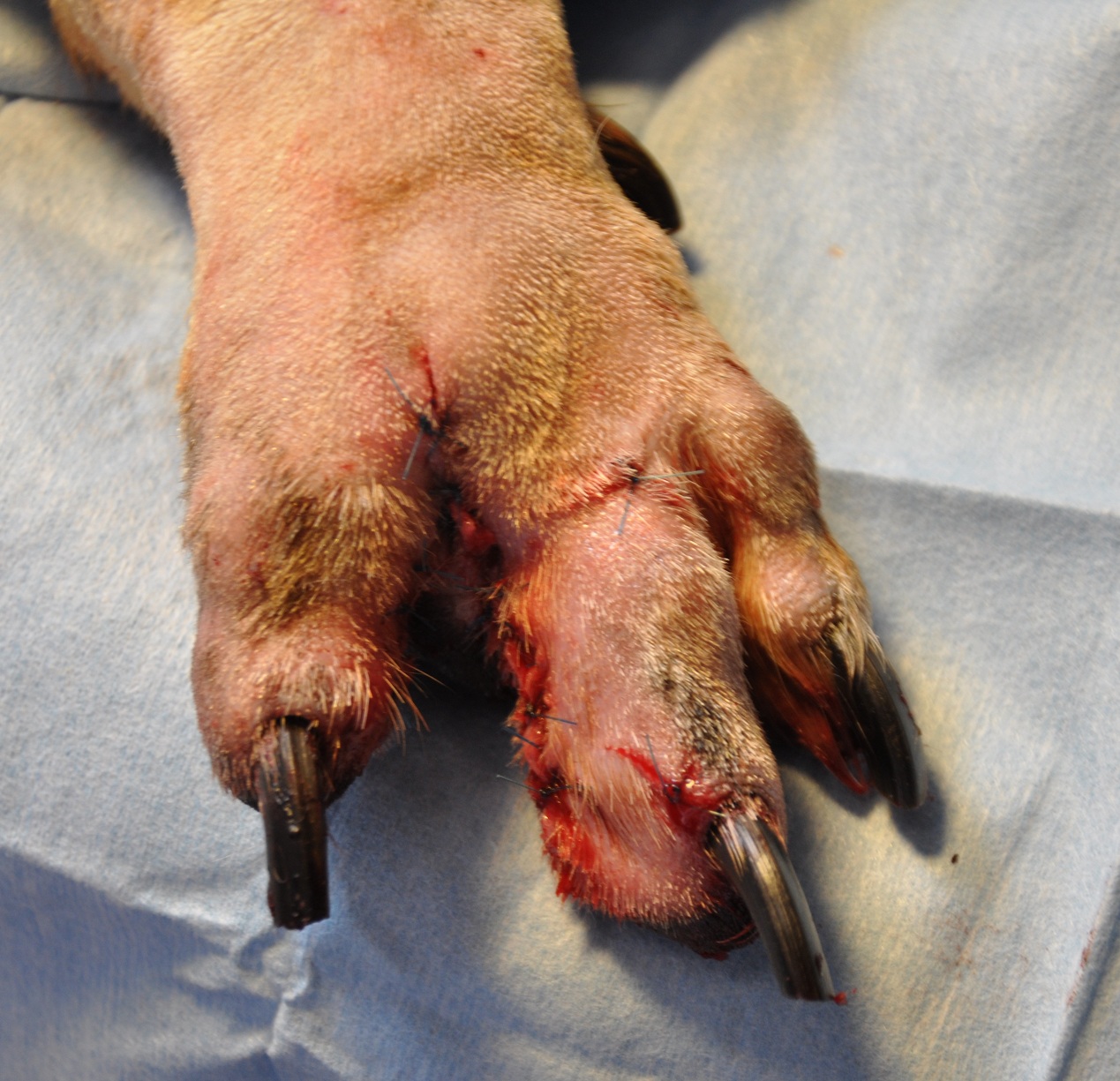
OK the pictures in this post are not for the faint of heart.  This is a case of a very sweet dog that had something go horribly wrong with one of her toes.  Her owner contacted us shortly before Christmas because her toenail looked infected.  In the two weeks from when her owner called and we saw her the toe had swollen to double it's normal size.  We started treating her for a bad infection and the toe continued to get worse. 
Our next step was to get some radiographs of her toe and chest (to check for metastasis of possible cancer) to see what was going on under the skin.  The radiograph pictured is of her affected foot looking down on it.  You can see the circular swelling of the affected toe.  Look closely at the other toes.  You can see what a normal toe looks like with three phalanyx and the nail visible.  Compare that with the affected toe and you can see the nail and part of that phalanx no longer exists.  You can also see a periosteal reaction (inflammation of the periosteum, the outer lining of the bone) seen as a white fuzzy outline around the bone of that toe.  On first glance this appears to be a cancer of the bone, but there is a good chance that this may just be a serious infection of the bone.  She could have stepped on something or chewed on her toe creating an open sore that was then susceptible to bacteria.    Since conservative treatment with antibiotics did not help we are now at a point where the toe needs to come off. 
We scheduled surgery and in the few days between the x-rays and the surgery she managed to chew a large hole in the side of her toe.  There was also evidence of gangrene starting to set in. 
In the picture you can see where her toenail would have been and now there is just a large hole.  The hole on the side of her toe is from her chewing on her foot.  Amazingly with a toe like this she remained very sweet and loving and allowed us to do whatever was necessary to help her.
Surgery was performed and the toe was sent out for a culture and for histopath.  We will see her for a bandage change on Monday and are still waiting on results of her tests.  She is on some heavy duty antibiotics and pain meds for now and is actually starting to put weight back on her foot (which is bandaged) again.  I'll let you know what we find.  Keep your fingers crossed and say some prayers for her that she is now on the road to recovery!

Sunday, November 20, 2011

Is turkey bad for our pets?

Well the holiday season is almost upon us and Anne had the question "Is it true that turkey is not healthy for our dogs?"  So I decided to write this blog about just that.

Anne your question is a complex one.  Because the answer is both yes and no.  Turkey is not bad for dogs that are used to eating it, especially when it is an ingredient in a balanced dog food.  There is nothing toxic or dangerous in turkey meat for our dogs.  The problem comes when our pets who are used to eating a well balanced, set ratio of fat, protein and carbohydrates, suddenly get a high fat treat.  Think about how you would feel if you ate a healthy diet of fruits, vegetables, and lean meat and then suddenly you went to McDonalds and got a Big Mac.  My guess is that you would not be feeling so hot for the rest of the day or even for several days.  That is the best case scenario for a dog that gets a high fat treat: a little belly ache, some gas, and diarrhea.

Turkey (or other fattening scraps like butter, gravy, etc.) become dangerous when they cause the pancreas to kick into high gear.  Eighty to ninety percent of all pancreatitis cases in humans are found in alcoholics or people with gallstones.  It is not a disease most people need to worry about.  That is not the case in dogs and cats.  They are much more sensitive to a sudden changes in fat intake. 

When your pet eats a meal several things happen.  Before the first bite of food is taken salivary secretions increase.  This then triggers the stomach to start producing more acid chyme (pronounced kime) which is responsible for the acidic environment of the stomach which allows the dog and cat to eat dead and decaying things with high bacterial contamination and not get sick.  The increase in chyme stimulates the duodenum (first part of the small intestines) to produce secretin which then causes the pancreas to produce its digestive enzymes.  These enzymes are responsible for the breakdown of fats and proteins. OK enough digestive physiology!

Because the digestive enzymes the pancreas produces will break down fats and proteins they are capable of digesting the pancreas and other internal organs as well.  There are protective measures in place to prevent this and under normal circumstance they are very effective.  The theory is that with a sudden high fat meal the pancreas over secretes enzymes to the point that the safety mechanisms are overcome.  (I always picture the I Love Lucy episode in the candy factory where the conveyor belt is put on super fast speed and she can't keep up). These enzymes then start to digest the pancreas itself causing more inflammation, unregulated production of more enzymes, and hence more damage.  A single high fat meal could be fatal for a dog or cat.  Once the enzymes damage the pancreas enough they can start to leak into the rest of the body and eventually general organ failure, DIC, and death can follow.  While many cases of pancreatitis are successfully treated, there is no guaranteed cure.  A dog or cat may stay in the hospital in intensive care for weeks (and thousands to tens of thousands of dollars), appear to be getting better, only to suddenly die from organ failure.

I know many people will think "but I've fed my dog table scraps at Thanksgiving for years and never had a problem."  All I can say to them is they were lucky.  I know many people that didn't wear a seat belt as a child and they are here to tell about it, but I know of at least three people who died because they weren't, the same theory applies.  I can also name many people that did feed their dog Thanksgiving scraps only to lose their beloved pet from severe acute pancreatitis or have to spend hundreds and thousands of dollars to get them through the illness.  So next time your dog looks up at you with those pleading soulful eyes while you are eating Thanksgiving dinner, think long and hard about what is best for him.  Hand him a raw carrot or green bean or even have some dog treats at the table instead.

Friday, November 11, 2011

Demodex - Warning graphic pictures of wounds

Today I am going to write about Demodectic mange in dogs.  Many people mistake demodex for scabies (Sarcoptic mange), but though clinical signs are similar they are two completely different organisms.  Scabies is contagious to people and other dogs while demodex is not.  All dogs have demodectic mites living on their body.  They are typically well controlled by the dog's immune system and cause no problems.  Sometimes, however, a dog is born with an immune problem and is unable to suppress the mite OR an older dog gets sick and his immune system is suppressed so much that he can no longer prevent multiplication of the mite. 

The mites look like little caterpillars, but can not be seen with the naked eye.  Instead people begin to notice patches of hair loss.  This is because the mites live down in the hair follicle causing the hair to fall out.  The are passed from dog to dog through prolonged contact (typically from mother to pup while they are nursing) and are species specific (meaning people can't get dog demodex).  To diagnose demodectic mange the affected area must be scraped down to the dermis (small amount of bleeding) and looked at under the miscroscope.  Finding a mite in a normal dog is nearly impossible because there are so few present.  Occasionally the mites live deep down (especially on the feet) and a biopsy is necessary to make the diagnosis.

There are two forms of demodex:  localized and generalized.  Localized demodex is classified as up to six small areas of alopecia (hair loss) generally on the face, head, and forelegs.  Generalized demodex is classified as more than six lesion, large affected areas, or involving more than one paw.  Localized demodex is a common puppy ailment that typically resolves on its own with or without treatment.  Treatment may be necessary if there is secondary infection, but often a rotenone based medication called Goodwinol is prescribed more to make the owner feel that they are doing something though it may shorten the time the lesion is visible.

Generalized demodex is a severe and possibly life threatening condition commonly occurring in dogs less than 18 months of age and in older dogs that have a reason for a suppressed immune system. Fortunately with proper treatment the signs can often be controlled or even completely resolved (until the next time the dog's immune system is suppressed). I have recently seen two cases in the last 6 months.  One in a young puppy that was rescued after being abandoned in the middle of winter and another in an elderly dog.
 
Piper is an absolutely sweet, loving Labrador that was adopted by a friend of mine after she was found abandoned.  She was treated when she first got her last January with ivermectin and antibiotics.  I saw Piper in June because she had a sever flare up.  In a matter of a few days she went from looking like a normal dog to one that you would expect to find slinking in alleys and half starved (she was not and this is a common presentation for the disease).  I personally know her owners and they take very good care of her and called me as soon as she started showing signs again.  She also healed very quickly and is still being treated to prevent another outbreak.

The most severe case I have seen in an older dog occurred in a 13 year old Labrador retriever. I was called out to see Thunder,  because in a matter of 1-2 days he suddenly developed severe bleeding wounds.  His owners were afraid that they might have to have him euthanized because he was so miserable. 
Fortunately we were able to make a quick diagnosis of demodectic mange with a secondary staph infection and start treating for both.  In just a few days he started feeling better, was scratching less and acting more normal.  In one month he was already healing very well.   Both his owners and I were estatic at his progress.  We ended up having to treat him with ivermectin for  2 and 1/2 months and his last skin scraping was finally negative!  I unfortunately did not take a picture of him looking normal again.
We looked for the underlying cause of Thunder's outbreak of demodex and were never able to pin point it, but hopefully it was stress or infection induced and won't bother him again. 
A point to note is that if you have a dog with a skin problem I recommend asking your vet to perform a skin scrape to rule out demodex.  Though it is fairly uncommon in adult dogs if left undiagnosed it could cause serious problems, especially since the treatment of skin ailments often involves the use of steroids.  Steroids like prednisone will cause an explosion of the mites and severe worsening of the clinical signs.

Sunday, October 23, 2011

Training dogs

OK.  I have been slacking the last two weeks and didn't write a blog.  I apologize for that, I was truly being lazy!  Anyways I am going to talk about proper training techniques for dogs and puppies.  I know there are a lot of people that like watching Caesar Milan and think he is the be all end all with dog training, but I have to disagree on a lot of points.  First of all it helps to understand a little bit about how dogs view the world.

Think of our canine companions as a mix between wolves and toddlers.  They are as intelligent as a 2 year old, but can be a 2 year old with a hunting knife!  Decedents of wolves have been co-habitating with humans for a minimum of 12,000 years and some recent DNA research puts that time frame closer to 135,000 years!  In the beginning dogs helped with protection, hunting, and keeping us warm.  In return we shared scraps and affection. In today's world dogs rely on us for all aspects of their care just like young children do.  They look to us for security and for companionship, yet they are our protectors and our best friends.  It is important to understand how a dog thinks and sees the world in order to help them fit into our mold of an ideal canine companion.

In the past many training techniques focused on negative reinforcement and fear as a motivator.  This training method hinders the full potential of the canine-human bond.  The dominance based training methods of the past are continually being proven to be inferior to newer training methods.  This goes contrary to how many people think.  Doesn't the alpha wolf dominate the rest of the pack?  Don't the submissive dogs roll on their backs and look away?  The answer is in a very few circumstances they do, but most of the time the alpha leaders (male and female) of the pack are respected and benevolent leaders.  An alpha wolf does not have to bully the pack to assert his dominance.  Instead he leads by taking care of the pack first with confidence and wisdom.  So why then do many trainers still insist that we dominate our dogs?

If we look at our dogs as children in fur coats then the idea of teaching with correction and dominance begin to make even less sense.  Ask any mother of a two year old and they will tell you that redirection is a far more effective method of keeping everyone happy than trying to constantly reprimand them.   I've had many arguments with my husband on this topic when our oldest was in her 1's and 2's and he finally had to agree that a 2 year old just doesn't have the mental capacity to understand a lot of things and it is much easier to substitute or distract than it is to yell and fuss and punish.  Dogs are very similar.

The training methods of behaviorists like Ian Dunbar believe in a more hands-off, reward based system.  This system promotes confidence in the human and the dog as well as building a bond of trust rather than a bond based on fear.  Second these training methods are safe, easy, and fun to use for the average pet owner.  Dominance based methods are much more likely to get someone bit or create a more aggressive and fearful dog. 

How to make a friendly dog:  If you obtain your puppy at 8 weeks of age, it isn't too young to start training.  In fact by doing so at such a young age you are more likely to have a happy, friendly well adjusted canine companion.   The socialization window for dogs ends by about 12 weeks of age.  Begin by introducing your new puppy to at least four new people each day.  Pick people of all different shapes, sizes, ages, gender, etc.  The more people your puppy is exposed to the more people he will be willing to accept as "normal".   Hand feeding your puppy during the socialization exercises will help your puppy to associate strangers with good things.  If your adopt your puppy or dog after a few months of age then you may have to proceed a little slower.  She may already be nervous around new situations.  Make each interaction a positive experience and don't push her beyond her endurance.  Only feed your dog during these social interactions.  This is meal time and she will learn that strangers are a part of this. 

Language of dogs:  Despite the fact that many people believe their dogs completely understand them, this is not the case.  Dogs are capable of learning some of our words, but they are even more capable of reading our body language, odors, and voice tones.  Because of this it seems like they understand us when we talk to them.  When creating command words for dogs it is important to me consistent and use simple words.  Telling a dog to "Stop"  or "No" is much better than "No! No! Buddy don't do that, bad dog!"  Your dog will understand the few words and tone, but nothing in between and the rest may just confuse him.  Pick simple words like "Yes" or "Good" when your dogs does what you want, "Oops"  or "Nay" to mean that your dog didn't quite get it right, and "Stop"  or "No" for a true forbidden activity such as peeing on the carpet, of chewing the baby's toy.  Overuse of the "No" command words makes them less effective, just like with children.  Having the "Oops" command lets the dog know that they didn't do what you wanted, but they aren't in trouble and didn't break any serious rules.  It keeps the tone positive and keeps the dog more willing to continue to try and get it right.

House-Training:  Most dogs can not hold their bladder for six hours until they are at least six months of age.  The first step to successful house training is to introduce your dog to a crate.  Crates are a useful tool and can become your dog's safe haven when he wants to be left alone.  Crates only become cruel when a dog is left in one 24 hours a day, 7 days a week.  Whenever you are not keeping your eyes directly on the puppy he should be in his crate.  The crate needs to be small enough so the puppy doesn't feel he can eliminate on one side and still sleep on the other.  You need to take your puppy out at LEAST 6 times a day and especially after eating or drinking.  Pick a particular spot outside to use as the "elimination" area.  Take your puppy out on a leash (even if you have a fenced in back yard).  Don't distract your puppy with talk or play.  Bring him to the spot and use a command such as "Go potty".  Praise him profusely when he does go.  Then have some outdoor playtime.  If you immediately bring him back into the house he will be more likely to waste time to avoid having to go directly back into the house. If your puppy has an accident in the house it is YOUR FAULT.  YOU are responsible for watching your puppy and looking for signs that he needs to eliminate.  If you catch him in the act, a firm "No", pick him up and take him immediately outside to the elimination spot.  Praise him if he finishes going.  If you find an accident in the house then just sigh and clean it up.  Rubbing his nose in it teaches the puppy nothing.  If you can't watch the puppy put him in his crate or in a play area where he can't ruin anything if he has an accident.

 Chewing:  Puppies and some dogs like to chew.  Their mouths are a very important part of they ability to sense the world around them.  Also young puppies, even up to a year of age are still cutting their teeth and chewing helps to alleviate some of the discomfort.  Teach your puppy which toys are acceptable to chew on by putting part of their daily dry kibble inside a kong treat or other hallow treat.  Place these in the basket or area where his other toys are kept.  When you find him chewing on something that is not allowed make a trade.  Don't just take it away and tell him no.  Tell him "No!" and then give him a toy so you can tell him "Yes!"  If your puppy is chewing on you then you can let out a yelp and freeze for a few seconds.  Your puppy will likely become apologetic.  Forgive him and continue to play, possibly using other toys that he can bite harder on.

There are a lot of excellent resources to help you, help your canine family member fit in well with your family.  Patience, compassion, consistency, and understanding your dog will go a long way.

Tuesday, October 4, 2011

Diabetes in Cats

I am currently managing several feline patients with diabetes so I thought that would be an appropriate topic to write about this week.  Much of this information can also apply to dogs, but I will focus on the disease in cats. So what is diabetes?  There are technically two types, diabetes insipidus and diabetes mellitus. Diabetes insipudus is a disease where the animal is unable to concentrate urine and not the topic of today.  I am going to discuss diabetes mellitus.
Diabetes mellitus is a disease where the body is unable to regulate blood sugar.  First of all it is important to understand how a normal cat regulates their glucose. Glucose is the energy source for all cells in the body.  When a cat eats a meal it is digested in the GI tract and the food broken down into it's basic parts of amino acids, fats, and sugars.  The liver then plays a further role in breaking down fats into usable glucose.  As glucose levels increase in the blood this triggers the pancreas to release insulin.  Insulin is the "key" that opens the cell door to allow glucose in.  Without this key the glucose can not enter the cell and the cell will not get any energy.  It is like being in the middle of the ocean, but not having any water to drink.  Most cat's suffer from Type II diabetes where the body may produce enough insulin, but no longer knows how to use it properly.
Because cats are not pack animals, they will hide illness until they are no longer able to.  This makes early detection difficult, even with the most astute owner.  Diabetes occurs in 1 out of 400 cats, but is becoming more common due to rampant obesity in companion animals.  Neutered male cats are twice as likely to develop diabetes than females, but cats weighing over 15 lbs and over the age of 10 are at  the greatest risk of developing diabetes.  Many experts also believe that a high carbohydrate diet predisposes cats to diabetes.  All dry foods and a majority of canned food contain a much higher percent of carbohydrate than cats need.  Once a cat develops diabetes this definitely plays a role in controlling the disease.
Regular check-ups every six months as well as screening bloodwork can be a very good way to detect the disease early.  The earlier the disease is diagnosed the more easily it is controlled.  Common signs that people first notice in a diabetic cat are increased drinking, increased urination, and weight loss despite a good appetite.  In more advanced stages weakness, wobbly gate, vomiting, anorexia are the common signs.
Diabetes is actually fairly easy to diagnose.  A small drop of blood to check glucose level will rule diabetes out if it is normal.  A blood glucose level above 200 mg/dl is a strong indication that the cat is diabetic.  Stress or a recent meal can falsely elevate glucose so a urinalysis or fructosamine level will need to be done to confirm the diagnosis.
If the diagnosis is made early enough many cats can be controlled by feeding a low carb diet.  Eventually about 70% of cats will need insulin to control the diabetes.  There are oral medications for humans to control diabetes, but most cat owners find it much more difficult to give a cat a pill than an injection.  Also the oral medications tend to be much less effective in controlling the diabetes and may promote further pancreatic cell damage.
Diets that are low in carbs, meaning less than 7% carbs, are difficult to find.  Purina DM canned is the only prescription diet that is available that has <7% carbs.  Janet& Binky'sCat Food Nutritional Information Page is a good resource for over the counter diets that are low carb.  You can't go by what the guaranteed analysis of a can says because they count water content so I recommend picking something off the list or calling the company and asking what percent of carbs are in the food on a dry matter basis.  Water intake is also a critical component to feline health, especially in sick cats.  For the last 10-15 years veterinarians have been preaching how important it is to feed your cat dry food for dental health, when in fact there are only a very few dry foods that actually do any cleaning of their teeth.  Dry foods are very high in carbs and low in water content.  We are now seeing other health issues such as renal disease, urinary tract disease, and diabetes that may be due to these dry diets.  So should all cats be fed canned food?  I honestly don't know, but more and more research is coming out to support the belief that they should.
OK back to the subject of diabetes.  Switching your cat to a low carb diet is a very important part of managing diabetes.  If your cat is already on insulin it is VERY important to note that he may suddenly no longer require as much insulin or any at all once switched.  Many cats can go into an insulin seizure or coma from getting the same dose of insulin they have been getting for months or years once switched to a low carb diet.  Careful glucose monitoring is critical to prevent this.  If your cat is newly diagnosed then many vets will start them on a low carb diet before insulin is started to see if the disease can be managed that way.  Regular insulin checks and close monitoring of water intake and urinary output are necessary to be able to quickly realize when diet control are no longer adequate and insulin will be needed.
Insulin therapy is often instantly rejected by many clients as an option.  People fear to give their cat injections once or twice a day and are afraid they will stress out or hurt their cat too much.  In fact I find it much easier to give a cat a subcutaneous injection than to pop pills down their throat.  With proper instruction most people can learn to administer these tiny injections.  Especially of done while the cat is eating or relaxed they often don't even seem to notice the shot.  Don't reject insulin therapy out of hand.  Worst case scenario is you try it and you can't do it.  Don't euthanize your diabetic cat without at least giving it an honest try.
Monitoring a diabetic is very important.  Once you are good at giving your cat insulin injections, learning how to prick their ear for a small blood sample to check glucose levels is an easy step.  This is the best way to monitor glucose.  A glucose curve is a very important test to see how your cat's body responds to the insulin injections.  This is a test where blood glucose levels are checked every 2 hours for a 12-16 hour period.  Taking your cat to the vet hospital to stay the day for this test is unlikely to give very accurate results due to the stress involved.  Being able to perform this test at home give a much better indication of the true effectiveness of the treatment.
Diabetes is a manageable disease that does not have to shorten your cat's life expectancy or overtly affect his quality of life.  Diabetes left untreated is a completely different story.  Uncontrolled high blood glucose levels lead to repeated urinary tract infections, kidney damage, neurological effects (weakness, dementia, seizures, coma), cataracts (more common in dogs), liver damage, dehydration, infection, and eventually death.